
Understanding the Global Mobile App Market
The global mobile app market presents vast opportunities for developers and businesses seeking international expansion. Rapid growth, diverse user preferences, and cultural nuances shape this dynamic landscape.
Market Size and Growth Projections
The mobile app market continues to expand at an impressive rate. As of 2024, over 5.5 million apps are available across Google Play and Apple’s App Store. This number is expected to grow further in the coming years.
Projections indicate that global app revenue will reach $613 billion by 2025, up from $318 billion in 2020. The Asia-Pacific region leads in app downloads and revenue, followed by North America and Europe.
Key growth drivers include increasing smartphone penetration, 5G adoption, and the rise of mobile-first economies in emerging markets.
User Behavior and Preferences
Mobile app usage varies significantly across different regions and demographics. In developed markets, users tend to spend more time on fewer apps, while emerging markets show higher app discovery rates.
Social media, gaming, and entertainment apps dominate global downloads. However, fintech and health apps have gained traction, especially since the COVID-19 pandemic.
User preferences for app features and design elements differ by region. For example:
- Asian markets favor visually rich interfaces with multiple functions
- European users often prefer minimalist designs with focused functionality
- Middle Eastern markets show a preference for voice-activated features
Cultural Sensitivities and Localization
Successful global app expansion requires a deep understanding of cultural nuances and local preferences. Localization goes beyond mere translation, encompassing cultural adaptation of:
- User interface design
- Graphics and icons
- Date and time formats
- Currency and measurement units
We must consider local regulations, such as data privacy laws in the EU (GDPR) or content restrictions in certain countries. Religious and social norms also play a crucial role in app acceptability.
Effective localization can significantly boost app engagement and retention rates. Studies show that localized apps experience up to 128% more downloads and a 26% increase in revenue compared to non-localized versions.
Developing a Localization Strategy
A well-planned localization strategy is crucial for successful app optimization in international markets. We’ll explore key aspects of language translation, content culturalization, and local compliance to ensure your app resonates with global audiences.
Language and Translation Considerations
Accurate translation is the foundation of app localization. We recommend using professional translators familiar with local dialects and idioms. Machine translation can be a starting point, but human review is essential for nuance and context.
Consider text expansion in translations. Some languages require more space than English, so design interfaces with flexibility.
Localize all app elements, including:
- User interface text
- App store descriptions
- In-app content
- Push notifications
- Support documentation
Implement a translation management system to streamline updates across multiple languages.
Culturalization of Content
Culturalization goes beyond translation to adapt the app’s entire user experience. We must consider local preferences, customs, and sensitivities.
Color schemes can have different meanings across cultures. Research color associations in target markets and adjust designs accordingly.
Adapt imagery to reflect local demographics and settings. This includes photos, illustrations, and icons.
Modify features based on regional needs. For example, some countries may prefer different payment methods or social media integrations.
Consider local holidays and events for timely content and promotions.
Local Regulations and Compliance
Adhering to local laws and regulations is non-negotiable. We must research and comply with data protection laws, such as GDPR in Europe or CCPA in California.
Understand age restrictions and content ratings for each market. Some countries have stricter guidelines for apps targeted at minors.
Be aware of local advertising regulations, especially for in-app promotions or ads.
Ensure compliance with local tax laws for in-app purchases and subscriptions.
Obtain necessary certifications or approvals required by local app stores or government agencies.
Regular audits help maintain compliance as regulations evolve.
App Store Optimization (ASO) for International Audiences
Expanding mobile apps to global markets requires tailored ASO strategies. We’ll explore key aspects of optimizing app listings for international audiences, focusing on localized keywords, culturally-relevant visuals, and effective review management.
Keyword Research and Metadata
Conducting thorough keyword research for each target market is crucial. We use specialized ASO tools to identify popular search terms in different languages and regions. Localized app titles, subtitles, and descriptions incorporate these keywords naturally.
App store algorithms consider metadata when ranking apps. We craft compelling, keyword-rich descriptions that resonate with local users. Character limits vary between app stores and languages, so we adapt content accordingly.
Localizing metadata goes beyond translation. We account for cultural nuances, idiomatic expressions, and local preferences. This approach improves discoverability and appeals to users in specific markets.
Visual Elements and Conversion Rates
App icons, screenshots, and preview videos play a vital role in attracting international users. We design visuals that align with local aesthetic preferences and cultural norms. This may involve adapting color schemes, imagery, or graphical elements.
Screenshots highlight key features and benefits, using localized text overlays. We showcase app functionality in ways that resonate with target audiences. A/B testing helps identify the most effective visual elements for each market.
App preview videos are powerful conversion tools. We create localized versions with region-specific content, voiceovers, and subtitles. These videos demonstrate app value propositions tailored to local user needs.
Ratings and Reviews Management
Positive ratings and reviews significantly impact app store rankings and user trust. We implement strategies to encourage satisfied users to leave reviews in their local app stores. This includes in-app prompts at optimal moments in the user journey.
Responding to user reviews in local languages shows commitment to customer satisfaction. We address concerns promptly and professionally, demonstrating responsiveness to international users.
Monitoring reviews across different markets helps identify region-specific issues or feature requests. This feedback informs localization efforts and product improvements, enhancing the app’s appeal in various markets.
User Experience and Interface Design
Optimizing user experience and interface design is crucial for mobile apps targeting international markets. Effective design considers readability, cultural navigation patterns, and customized visuals to create intuitive and engaging experiences for users worldwide.
Designing for Readability
We prioritize clear typography and appropriate font sizes to ensure content is easily readable across different devices and screen sizes. Sans-serif fonts often work well for digital interfaces. We consider line spacing and text alignment to enhance legibility.
Color contrast between text and background is essential for readability. We aim for a contrast ratio of at least 4.5:1 for normal text and 3:1 for large text.
We use concise language and break text into short paragraphs or bullet points. This approach improves scannability and comprehension, especially for non-native speakers.
Navigational Patterns Across Cultures
Navigation design must account for cultural differences in reading direction and user expectations. In right-to-left languages, we mirror the interface layout accordingly.
We use universally recognized icons where possible, but also localize icons that may have different meanings across cultures. For example, a mailbox icon might not be familiar in countries without home mail delivery.
Menu structures and hierarchies should reflect local user mental models. We conduct user research to understand how different cultures categorize and prioritize information.
Customizing Visuals and Interactions
Color choices consider cultural associations and preferences. Red may signify luck in China but danger in Western countries. We research color meanings for target markets and adjust our palette accordingly.
We adapt imagery to reflect local cultures, avoiding potentially offensive or misunderstood visuals. This includes photos, illustrations, and even emoji, which can have different interpretations across cultures.
Gesture controls may need adjustment. For instance, the “swipe” gesture is less common in some Asian markets. We provide alternative interaction methods and clear visual cues for unfamiliar gestures.
Marketing and Promotion Across Borders
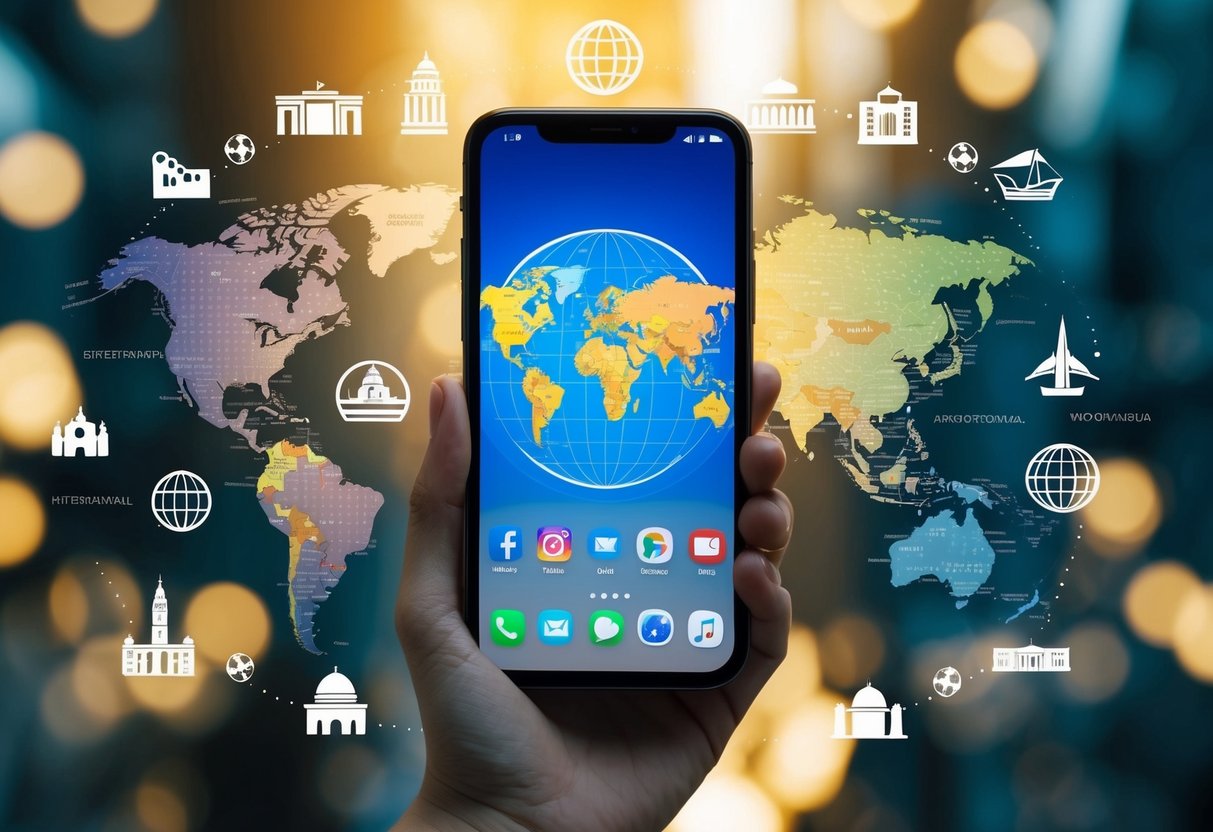
Expanding a mobile app to international markets requires careful planning and execution of marketing strategies. We’ll explore key approaches for reaching and engaging global audiences effectively.
Segmentation and Targeting
Identifying the right audience segments in each target market is crucial. We analyze demographic data, user behaviors, and local preferences to create detailed customer profiles. This information guides our marketing efforts and helps allocate resources efficiently.
We use geographic and psychographic segmentation to tailor our messaging. For example, we might focus on young professionals in urban areas of Japan, while targeting families in suburban regions of Brazil. Understanding these nuances allows us to craft more relevant and impactful campaigns.
Local market research is essential. We conduct surveys, focus groups, and analyze competitor strategies to gain insights into each region’s unique characteristics.
Cultural Adaptation of Marketing Campaigns
Adapting marketing content to local cultures goes beyond mere translation. We consider cultural norms, values, and sensitivities when crafting our messages. This includes adjusting visuals, colors, and symbols to resonate with the target audience.
We localize app store pages with region-specific keywords, descriptions, and screenshots. This improves discoverability and appeals to local users. Our marketing materials reflect local holidays, events, and traditions to create a stronger connection.
We also adapt our value propositions to address specific pain points in each market. What works in one country may not be as effective in another, so we remain flexible in our approach.
Influencer and Social Media Strategies
Leveraging local influencers can significantly boost app visibility and credibility. We identify and partner with influencers who align with our brand values and have a strong following in our target markets.
We tailor our social media strategies to popular platforms in each region. For instance, we might focus on WeChat in China, while prioritizing Instagram in the US. We create content that fits each platform’s unique format and user expectations.
User-generated content campaigns can be particularly effective for building trust. We encourage users to share their experiences with our app, adapting the call-to-action to resonate with local audiences.
Payment Integration and Currency Conversion
Effective payment integration and currency conversion are crucial for mobile apps targeting international markets. These elements directly impact user experience and conversion rates across diverse regions.
Local Payment Methods
We recognize the importance of offering local payment options in each market. Popular methods vary widely between countries. In China, Alipay and WeChat Pay dominate, while Europeans prefer bank transfers and digital wallets. Latin American users often rely on cash-based voucher systems.
To maximize conversions, we integrate multiple payment gateways that support region-specific methods. This approach allows users to pay using familiar, trusted options. We also ensure our app’s user interface adapts to display relevant payment choices based on the user’s location.
Security is paramount when handling financial transactions. We implement robust encryption and comply with international standards like PCI DSS to protect user data and build trust.
Pricing Strategies for Different Markets
Pricing strategies must account for local economic conditions and user expectations. We employ dynamic pricing models that adjust based on factors like purchasing power parity, competitor pricing, and market demand.
In some cases, we offer tiered pricing structures with market-specific features or content. This allows us to cater to different income levels within a single country.
We also consider cultural factors in pricing. For example, in some Asian markets, prices ending in 8 are considered lucky and may increase sales. Conversely, we avoid unlucky numbers in other regions.
A/B testing helps us refine our pricing strategies. We continuously analyze user behavior and conversion rates to optimize our approach in each market.
Handling Multiple Currencies
Supporting multiple currencies is essential for a seamless user experience. We display prices in the user’s local currency, updating exchange rates in real-time through integration with reliable currency APIs.
Our app stores and processes transactions in a base currency, typically USD or EUR. We then convert to the user’s local currency at checkout. This approach simplifies accounting and reduces exchange rate risk.
We clearly communicate any fees associated with currency conversion to maintain transparency. In some cases, we offer users the option to pay in the base currency if they prefer.
To manage exchange rate fluctuations, we implement safeguards like currency hedging and periodic price adjustments. This helps maintain profit margins while keeping prices stable for users.
Customer Support and Service Localization
Effective customer support is crucial for international app success. Localizing support services ensures users across markets receive timely, culturally-appropriate assistance in their preferred language.
Multilingual Support Teams
We prioritize building diverse support teams fluent in target market languages. This enables direct communication with users, avoiding misunderstandings from translations.
We recruit native speakers or those with near-native proficiency. They understand linguistic nuances and idioms, providing more natural interactions.
Our teams use localized knowledge bases and support materials. This ensures consistent terminology and guidance across languages.
We implement translation tools and glossaries to maintain consistency in technical terms and product names across support channels.
Cultural Training for Customer Support
We provide comprehensive cultural training to our support staff. This covers communication styles, etiquette, and cultural sensitivities for each target market.
Our training includes:
- Appropriate greetings and formalities
- Nonverbal communication norms
- Taboo topics or gestures to avoid
- Local holidays and customs
We teach staff to adapt their tone and approach based on cultural preferences. For example, some cultures value direct communication, while others prefer indirect methods.
Regular cultural awareness workshops keep our teams updated on evolving norms and practices in different markets.
Support Channels and Infrastructure
We tailor our support channels to match local preferences. This may include:
- Phone support
- Live chat
- Social media platforms
- Messaging apps popular in specific regions
Our infrastructure accommodates different time zones, ensuring 24/7 availability where needed. We use follow-the-sun models to provide round-the-clock support efficiently.
We localize self-service options like FAQs and knowledge bases. This empowers users to find solutions independently in their preferred language.
Our ticketing systems support multiple languages and character sets, facilitating seamless issue tracking across global support teams.
Analytics and Performance Metrics
Analytics and performance metrics are crucial for optimizing mobile apps in international markets. They provide valuable insights into user behavior, app functionality, and overall success across different regions.
Setting and Tracking International KPIs
Key Performance Indicators (KPIs) for international markets should focus on user acquisition, engagement, and retention. We recommend tracking metrics like downloads per country, daily and monthly active users, and session length across regions.
User retention rates are particularly important, as they indicate an app’s long-term viability in each market. Monitoring in-app purchases and revenue by country helps identify the most lucrative markets.
It’s essential to set region-specific benchmarks, as user behavior can vary significantly between countries. We suggest using cohort analysis to compare user groups across different markets and identify trends.
User Feedback and Improvement Cycles
Collecting and analyzing user feedback is vital for continuous improvement in international markets. We recommend implementing in-app feedback mechanisms and regularly monitoring app store reviews in each country.
Sentiment analysis tools can help process feedback in different languages, allowing us to identify common issues or requests across markets. It’s important to prioritize improvements based on user impact and feasibility.
A/B testing different features or UI elements in specific regions can provide valuable insights into local preferences. We suggest implementing rapid iteration cycles to quickly address user concerns and improve the app experience.
Benchmarking Against Competitors
Comparing our app’s performance against competitors in each market is crucial for staying competitive. We recommend using app store intelligence tools to track competitor rankings, ratings, and user acquisition strategies in different countries.
Analyzing competitors’ feature sets and user reviews can help identify gaps in our own offering or potential areas for differentiation. It’s important to monitor competitors’ localization efforts and pricing strategies in each market.
We suggest creating a competitive scorecard for each key market, tracking metrics like market share, user ratings, and feature parity. This allows us to quickly identify areas where we need to improve to stay competitive in specific regions.
Technical Considerations for Scalability
Scaling a mobile app for international markets requires careful attention to technical infrastructure, global performance optimization, and streamlined update processes. These elements form the foundation for successful expansion across diverse regions.
Infrastructure and Data Residency
Cloud infrastructure plays a crucial role in scaling mobile apps globally. We recommend using distributed cloud services to host app data and services closer to end-users. This approach reduces latency and improves app responsiveness.
Data residency laws vary by country. It’s essential to understand and comply with local regulations regarding data storage and processing. In some cases, we may need to set up regional data centers to meet legal requirements.
Load balancing across multiple servers helps distribute traffic and prevent bottlenecks. We implement auto-scaling solutions to automatically adjust resources based on demand, ensuring smooth performance during usage spikes.
Optimizing App Performance Globally
Network conditions vary widely across international markets. We optimize our apps to perform well on slower connections by implementing efficient data compression techniques and minimizing payload sizes.
Caching strategies are crucial for reducing server load and improving response times. We use a combination of local device caching and content delivery networks (CDNs) to serve static assets quickly.
Image and video optimization is key for markets with limited bandwidth. We employ adaptive streaming and progressive loading techniques to enhance user experience across different network conditions.
Update Deployment and Version Control
A robust version control system is essential for managing app updates across multiple regions. We use Git for source code management and implement branching strategies to handle region-specific features.
Staged rollouts help mitigate risks associated with updates. We deploy new versions to a small percentage of users first, gradually increasing the rollout based on performance metrics and user feedback.
Over-the-air (OTA) updates allow us to push critical fixes and improvements without requiring users to manually update. We implement delta updates to minimize download sizes and conserve users’ data.
Legal Aspects of International App Distribution
Distributing mobile apps globally requires navigating complex legal landscapes. Different countries have varying regulations that impact app development, distribution, and monetization strategies.
Intellectual Property Rights
Protecting intellectual property (IP) is crucial when expanding into international markets. We must secure copyrights for our app’s code, content, and design elements in each target country. Trademarks for app names and logos should be registered to prevent unauthorized use.
Patent protection may be necessary for novel features or technologies. However, patent laws differ significantly between jurisdictions. Some countries don’t allow software patents at all.
We should conduct thorough IP searches to avoid infringing on existing rights in new markets. Licensing agreements may be required to use third-party technologies or content internationally.
Data Privacy and Protection Laws
Data privacy regulations vary widely across countries and regions. The EU’s General Data Protection Regulation (GDPR) sets strict rules for collecting and processing user data. We must obtain explicit consent and provide transparency about data usage.
Other notable laws include:
- California Consumer Privacy Act (CCPA)
- Brazil’s General Data Protection Law (LGPD)
- China’s Personal Information Protection Law (PIPL)
We need to implement robust data security measures and allow users to access, correct, and delete their personal information. Localized privacy policies and terms of service are essential for each market.
Partnership and Revenue Sharing Agreements
Collaborating with local partners can facilitate market entry and compliance. We should carefully negotiate distribution agreements with app stores, telecom operators, and other platforms.
Key considerations include:
- Revenue split percentages
- Payment terms and currencies
- Tax implications
- Dispute resolution mechanisms
In-app purchase regulations differ by country. Some require specific pricing tiers or mandate local payment options. We must adapt our monetization strategies accordingly to maximize revenue while staying compliant.
Frequently Asked Questions
Mobile app optimization for international markets involves several key considerations. Businesses must navigate localization challenges, cultural nuances, and user experience expectations across diverse global audiences. Effective strategies and analytics play crucial roles in successful expansion.
How can businesses optimize their mobile apps for different international markets?
We recommend starting with thorough market research. Identify target countries and analyze local app usage trends. Adapt the app’s interface, content, and functionality to meet regional preferences. Localize app store listings, including titles, descriptions, and keywords. Ensure compliance with local regulations and payment systems.
What are the key strategies for successful international mobile app localization?
Translate all app content accurately, including in-app text and metadata. Use native speakers to capture linguistic nuances. Adapt graphics, icons, and color schemes to suit cultural preferences. Implement right-to-left layouts for languages like Arabic. Test the localized versions thoroughly with users from target markets.
What role does cultural adaptation play in mobile app internationalization?
Cultural adaptation is crucial for app success in foreign markets. Consider local customs, holidays, and social norms when designing features and content. Avoid potentially offensive imagery or references. Tailor marketing messages to resonate with local audiences. Adapt user interfaces to match regional expectations for layout and navigation.
How important is user experience in mobile app optimization for global markets?
User experience is paramount in global app optimization. Design intuitive interfaces that cater to local user behaviors. Optimize app performance for popular devices in each market. Ensure fast loading times and smooth navigation. Provide excellent customer support in local languages. Regularly gather and act on user feedback from different regions.
What are the common challenges when marketing mobile apps internationally?
How can developers use analytics to enhance mobile app performance in various markets?
Analytics are vital for optimizing international app performance. Track user behavior, engagement, and retention rates by region. Analyze app store performance metrics for each localized version. Use A/B testing to refine features and designs for specific markets. Monitor crash reports and performance issues across different devices and operating systems popular in target countries.
