
Understanding Video and Image SEO

Video and image SEO involves optimizing visual content to improve visibility in search results. We’ll explore key strategies for enhancing media discoverability and engagement.
Essentials of SEO for Visual Content
High-quality, relevant visuals are crucial for effective SEO. We prioritize image and video relevance to the surrounding content. Proper file naming helps search engines understand visual elements. Descriptive alt text for images improves accessibility and provides context for search algorithms.
Compression techniques reduce file sizes without sacrificing quality, improving load times. We recommend using modern file formats like WebP for images and MP4 for videos to balance quality and performance.
Responsive design ensures visuals display correctly across devices. Sitemaps that include image and video URLs help search engines discover and index this content more efficiently.
The Role of Metadata in Media SEO
Metadata provides crucial information about visual content to search engines. For images, we focus on alt text, captions, and surrounding text to provide context. File names should be descriptive and include relevant keywords.
Video metadata includes titles, descriptions, and tags. These elements help search engines understand video content and improve rankings. Transcripts and closed captions make videos more accessible and provide additional text for indexing.
Schema markup enhances how visual content appears in search results. We implement VideoObject and ImageObject schemas to provide structured data about our media, potentially leading to rich snippets in search results.
Understanding Search Engine Algorithms for Video and Image Content
Search engines use advanced algorithms to analyze and rank visual content. Image recognition technology allows algorithms to understand the content of images without relying solely on text-based information.
For videos, factors like watch time, engagement metrics, and relevance to search queries influence rankings. We optimize video thumbnails to improve click-through rates from search results pages.
User engagement signals, such as likes, shares, and comments, play a role in ranking visual content. Creating high-quality, engaging visuals that encourage interaction can boost SEO performance.
Search engines also consider the context in which images and videos appear. We ensure our visual content is embedded on relevant pages with supportive text to strengthen its SEO value.
Best Practices for Video SEO
Implementing effective video SEO strategies can significantly boost your content’s visibility and engagement. We’ll explore key techniques to optimize your videos for search engines and viewers alike.
Optimizing Video Titles and Descriptions
Crafting compelling titles and descriptions is crucial for video SEO success. Use relevant keywords in your titles, keeping them under 60 characters to avoid truncation in search results. Make titles catchy and descriptive to entice clicks.
For descriptions, front-load important information and keywords. Include a brief summary of the video content, relevant links, and a call-to-action. Aim for 150-200 words to provide ample context for search engines and viewers.
Incorporate target keywords naturally throughout the description. This helps search engines understand your video’s topic and relevance.
Creating Engaging and Relevant Thumbnails
A eye-catching thumbnail can dramatically increase click-through rates. Design custom thumbnails that accurately represent your video content and align with your brand.
Use high-contrast colors and clear, legible text if including any. Feature close-ups of faces or action shots to grab attention. Ensure your thumbnail looks good at various sizes, as it will be displayed differently across devices.
A/B test different thumbnail designs to identify what resonates best with your audience. Consistency in style across your video library can help build brand recognition.
Transcripts and Closed Captions
Adding transcripts and closed captions to your videos improves accessibility and SEO. Transcripts provide search engines with text to index, increasing the chances of your video appearing in relevant searches.
Use accurate, time-synced captions to enhance viewer experience. This is particularly important for viewers who are deaf or hard of hearing, or those watching without sound.
Include keywords naturally in your transcripts, but avoid keyword stuffing. Transcripts can also serve as a basis for creating blog posts or other content, extending the value of your video.
Video Sitemaps and Schema Markup
Implement video sitemaps to help search engines discover and understand your video content. Include essential information like video title, description, duration, and thumbnail URL.
Use schema markup to provide additional context about your videos. This structured data helps search engines display rich snippets in search results, potentially increasing click-through rates.
Ensure your video pages are crawlable and indexable. Host videos on your own domain when possible, or use platforms that allow for easy embedding and optimization.
Regularly update your video sitemap as you add new content or make changes to existing videos. This keeps search engines informed about your latest offerings.
Best Practices for Image SEO
Implementing effective image SEO techniques can significantly boost a website’s visibility and user engagement. We’ll explore key strategies to optimize images for search engines and users alike.
Optimizing Image File Names and ALT Text
Descriptive file names help search engines understand image content. We recommend using clear, keyword-rich names separated by hyphens. For example, “red-sports-car-2024.jpg” is more effective than “IMG001.jpg”.
ALT text is crucial for accessibility and SEO. It should accurately describe the image and include relevant keywords naturally. Keep ALT text concise, typically under 125 characters. For instance:
<img src="red-sports-car-2024.jpg" alt="2024 model red sports car on racetrack">
This approach aids visually impaired users and provides context for search engines.
Choosing the Right Image Format and Compression
Selecting appropriate image formats and compression levels balances quality and load speed. Common formats include:
- JPEG: Best for photographs and complex images
- PNG: Ideal for graphics with transparency
- WebP: Modern format offering superior compression and quality
We suggest using tools like ImageOptim or Squoosh to compress images without significant quality loss. Aim for file sizes under 200KB when possible.
Leveraging Image Sitemaps
Image sitemaps help search engines discover and index images more effectively. They’re especially useful for images that aren’t easily accessible through website navigation.
To create an image sitemap:
- List all important images on your site
- Include image URL, caption, title, and license information
- Submit the sitemap through Google Search Console
This practice ensures search engines can find and properly index your visual content, potentially increasing visibility in image search results.
Technical SEO for Multimedia

Technical SEO for multimedia content involves optimizing images and videos for faster loading, improved mobile experience, and enhanced search engine visibility. We’ll explore key strategies to boost multimedia performance and rankings.
Responsive Images and Lazy Loading
Responsive images adapt to different screen sizes, improving user experience across devices. We implement this by using the srcset attribute, which specifies multiple image versions for various resolutions. For example:

Lazy loading delays image loading until they’re needed, speeding up initial page load. We achieve this with the loading=”lazy” attribute:

This technique significantly improves page speed, especially for image-heavy sites.
Accelerated Mobile Pages (AMP) for Faster Loading
AMP is an open-source framework designed to create fast-loading mobile web pages. We use AMP HTML, a subset of HTML with restrictions, to ensure quick rendering. Key AMP elements include:
- amp-img for responsive images
- amp-video for optimized video playback
- amp-analytics for tracking user interactions
AMP pages typically load 4x faster and use 10x less data compared to non-AMP pages. This speed boost can lead to improved search rankings and user engagement on mobile devices.
Content Delivery Networks (CDN) and SEO Benefits
CDNs distribute content across multiple servers worldwide, reducing latency and improving load times. We leverage CDNs to serve multimedia content from locations closer to users. Benefits include:
- Faster page loading: Improves user experience and search rankings
- Reduced server load: Enhances site stability during traffic spikes
- Improved security: Many CDNs offer DDoS protection
To implement a CDN, we change image and video URLs to point to the CDN-hosted versions. This simple change can dramatically improve site performance and, consequently, SEO rankings.
Engagement Metrics and Their Impact on SEO
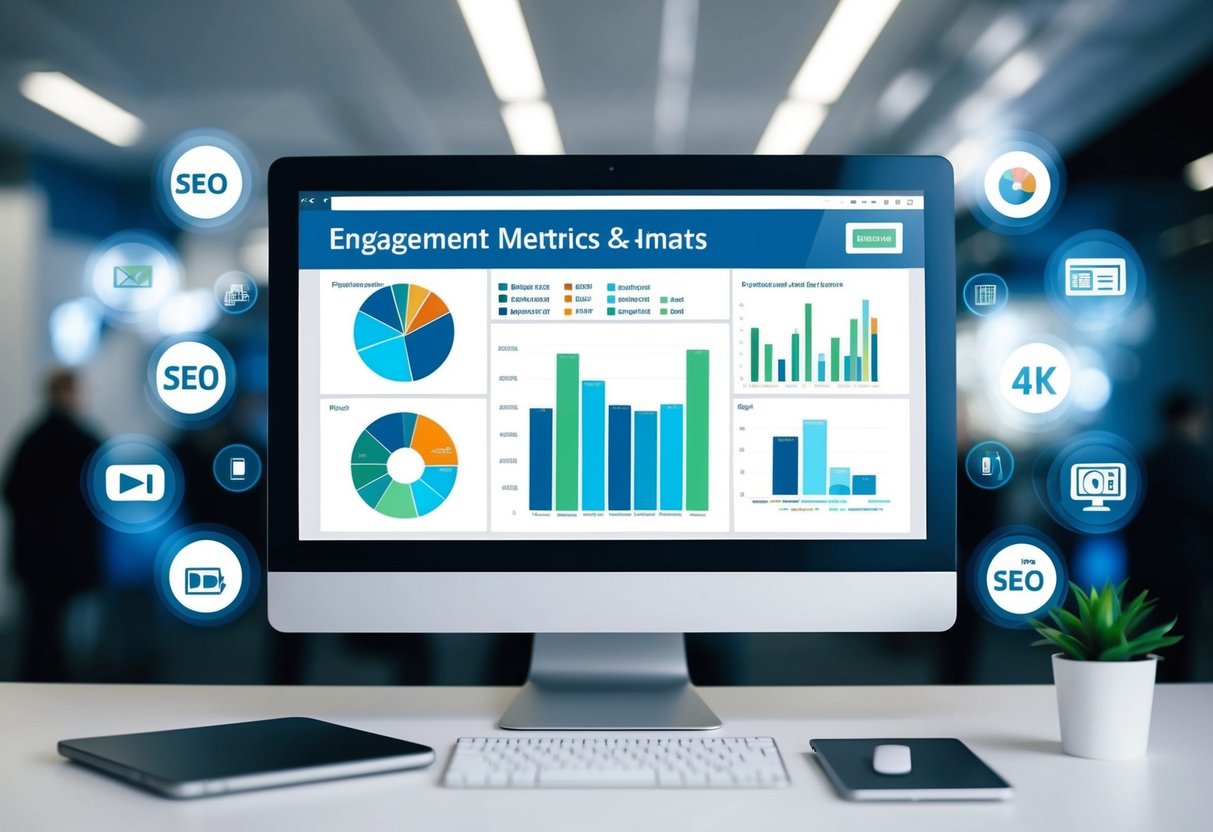
Engagement metrics provide valuable insights into how users interact with video and image content, directly influencing SEO performance. These indicators help search engines assess content quality and relevance.
Understanding Viewership and Bounce Rates
Viewership metrics are crucial for gauging content performance. They include view count, watch time, and completion rate. High view counts indicate popular content, but watch time offers deeper insights into engagement levels.
Bounce rate measures the percentage of visitors who leave a site after viewing only one page. For videos, this could mean viewers who exit shortly after starting playback. A low bounce rate suggests engaging content that keeps users on the site longer.
We can use these metrics to refine our content strategy. By analyzing which videos have higher watch times and lower bounce rates, we can create more of what our audience finds compelling.
Social Shares and Backlinks
Social shares and backlinks are powerful indicators of content quality. When users share videos or images on social platforms, it increases visibility and drives traffic. This social proof can boost SEO rankings.
Backlinks from reputable sites are even more valuable. They signal to search engines that our content is trustworthy and authoritative. To encourage shares and backlinks, we should:
- Create high-quality, shareable content
- Include social sharing buttons
- Engage with our audience in comments
- Reach out to relevant websites for potential link opportunities
User Experience and Dwell Time
User experience plays a significant role in SEO. Dwell time, the duration a user spends on a page before returning to search results, is a key metric. Longer dwell times suggest engaging content that meets user needs.
To improve dwell time, we can:
- Optimize video and image loading speeds
- Use descriptive titles and thumbnails
- Create playlists or galleries to encourage further exploration
- Provide transcripts for videos to enhance accessibility
By focusing on these user experience elements, we not only improve engagement metrics but also send positive signals to search engines about our content quality.
Advanced Strategies and Emerging Trends
Video and image SEO is evolving rapidly with new technologies and user behaviors. We’re seeing exciting developments in voice search, AI applications, and immersive content formats that are reshaping optimization practices.
Voice Search and Visual Content
Voice search is changing how users interact with visual content. We’re optimizing video titles and descriptions with natural language phrases that match voice queries. Including transcripts and closed captions helps voice assistants understand and surface video content.
For images, we’re focusing on detailed alt text that describes visual elements in conversational language. This makes images more accessible to voice search and screen readers.
We’re also seeing a rise in visual search capabilities. Optimizing images with descriptive file names, captions, and surrounding text improves their discoverability through visual search engines.
AI and Machine Learning in Image and Video SEO
AI tools are transforming how we approach image and video optimization. Machine learning algorithms can now:
- Automatically generate descriptive tags and captions
- Identify objects, scenes, and actions in visual content
- Transcribe speech in videos with high accuracy
We’re using these AI capabilities to enhance metadata at scale. This improves searchability while saving time on manual optimization.
AI is also powering more sophisticated image and video recommendation systems. We’re optimizing content to align with these algorithms, considering factors like user engagement and contextual relevance.
Augmented Reality (AR) and Virtual Reality (VR) Content
AR and VR are creating new categories of visual content to optimize. We’re applying SEO principles to 3D models, 360-degree videos, and interactive AR experiences.
Key optimization areas include:
- Descriptive titles and metadata for AR/VR assets
- Schema markup to indicate immersive content types
- Optimizing for AR-specific search features in mobile
We’re also focusing on creating high-quality thumbnails and preview images that entice users to engage with AR/VR content in search results.
As AR and VR become more mainstream, we expect search engines to develop new ranking factors specific to immersive content quality and user experience.
Frequently Asked Questions
Video and image SEO involves several key optimization techniques. Proper implementation can significantly boost search visibility and user engagement for visual content across platforms.
How can I optimize my videos for better search engine rankings?
We recommend focusing on descriptive titles, tags, and descriptions that include relevant keywords. Transcripts and closed captions also help search engines understand video content. Creating engaging thumbnails and organizing videos into playlists can improve click-through rates and watch time.
What are the best practices for video SEO?
Quality content is essential. We suggest producing valuable, informative videos that address user needs. Optimize metadata like titles and descriptions. Encourage engagement through likes, comments, and shares. Host videos on YouTube and embed them on your site for maximum visibility.
What role do thumbnails play in video SEO?
Thumbnails are crucial for attracting clicks. We advise using high-quality, eye-catching images that accurately represent video content. Custom thumbnails often outperform auto-generated ones. Including text overlays with keywords can boost relevance signals.
How do image alt tags contribute to SEO?
Alt tags provide context for search engines and improve accessibility. We recommend using descriptive, keyword-rich alt text for all images. This helps search engines understand image content and can improve rankings in image search results.
What factors affect image search rankings?
File names, alt text, and surrounding content are important ranking factors. We suggest optimizing these elements with relevant keywords. Image size, format, and loading speed also impact rankings. High-quality, original images tend to perform better in search results.
How important is file naming in image SEO?
Descriptive file names help search engines understand image content. We advise using relevant keywords separated by hyphens. This practice can improve image search rankings and overall site SEO. Avoid generic names like “IMG_001” in favor of descriptive ones.
